TAT Blog interesting astrophysics stories

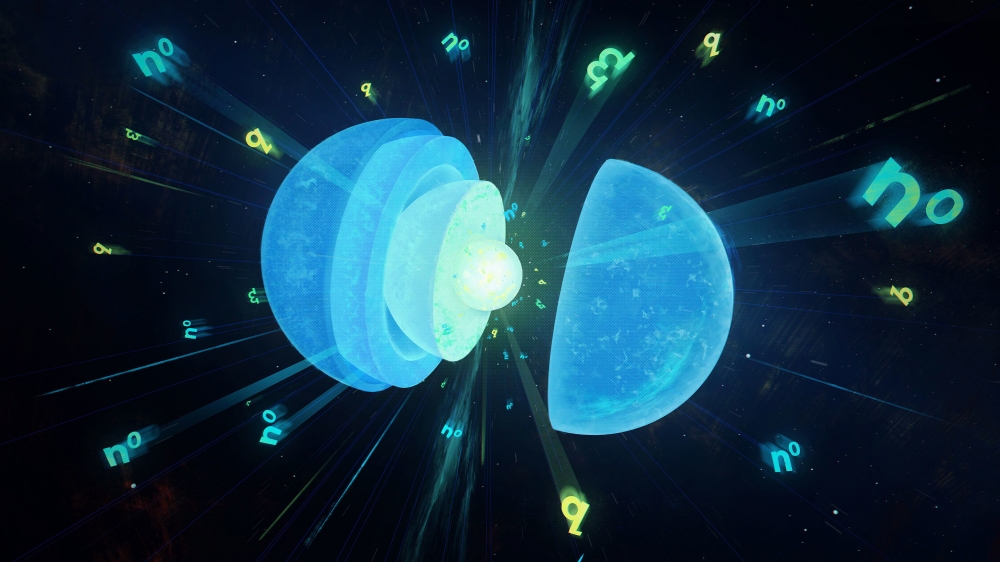
Squishy or Solid? A Neutron Star’s Insides Open to Debate
undefined

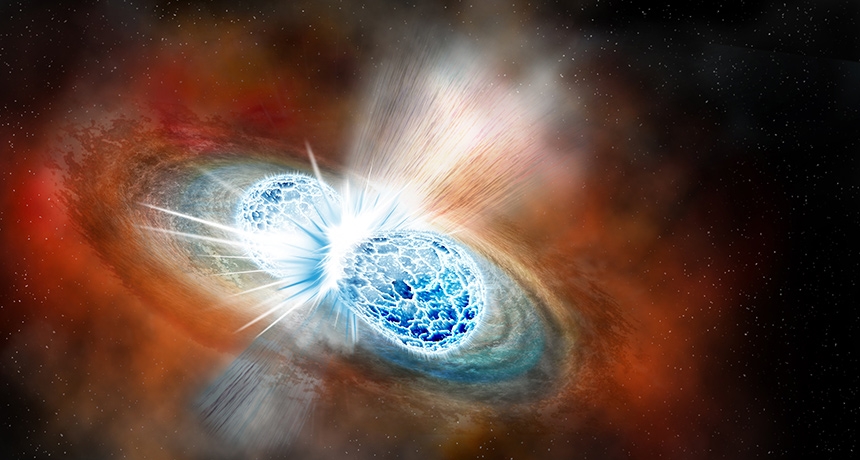
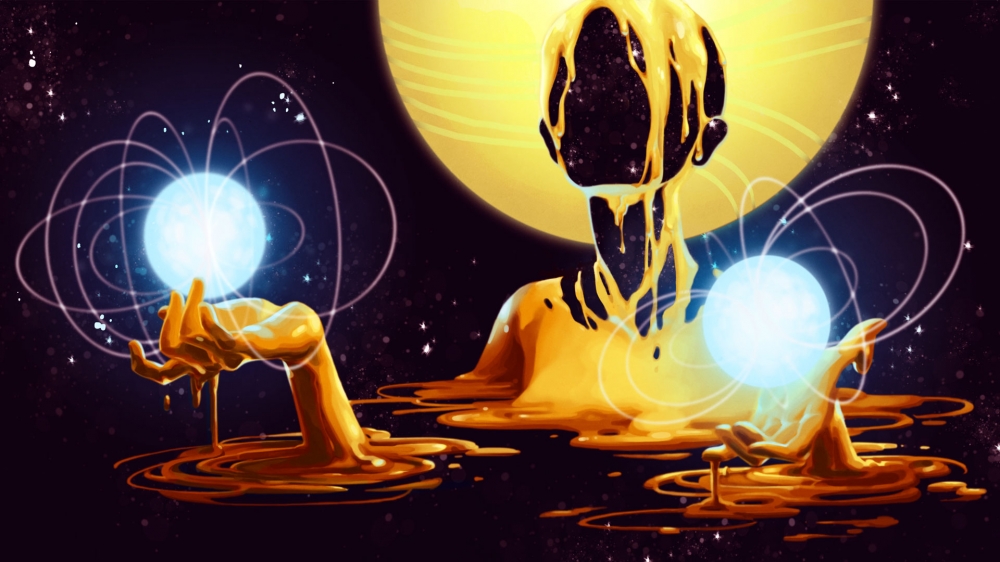
The core of a neutron star is such an extreme environment that physicists can’t agree on what happens inside. But a new space-based experiment — and a few more colliding neutron stars — should reveal whether neutrons themselves break down.

Joshua Sokol - Contributing Writer - October 30, 2017

The alerts started in the early morning of Aug. 17. Gravitational waves produced by the wreck of two neutron stars — dense cores of dead stars — had washed over Earth. The thousand-plus physicists of the Advanced Laser Interferometer Gravitational-Wave Observatory (LIGO) rushed to decode the space-time vibrations that rolled across the detectors like a drawn-out peal of thunder. Thousands of astronomers scrambled to witness the afterglow. But officially, all this activity was kept secret. The data had to be collected and analyzed, the papers written. The outside world wouldn’t know for two more months.

The strict ban put Jocelyn Read and Katerina Chatziioannou, two members of the LIGO collaboration, in a bit of an awkward situation. In the afternoon on the 17th, the two were scheduled to lead a panel at a conference dedicated to the question of what happens under the almost unfathomable conditions in a neutron star’s interior. Their panel’s topic? What a neutron-star merger would look like. “We sort of went off at the coffee break and sat around just staring at each other,” said Read, a professor at California State University, Fullerton. “OK, how are we going to do this?”


See full text
 

Many junior scientists need to take a hard look at their job prospects

undefined

NATURE | EDITORIAL

Permanent jobs in academia are scarce, and someone needs to let PhD students know.

For his 2012 PhD thesis, the sociologist Chris Platts surveyed and interviewed more than 300 young footballers — aged 17 and 18 — at UK club academies who were hoping to pursue a career in the game. He told the newspaper The Guardian this month that just four of them currently have gained a professional contract. That’s a drop-out rate of 99%.

For our Careers section this week, Nature surveyed more than 5,700 early-career scientists worldwide who are working on PhDs. Three-quarters of them, they told us, think it’s likely that they will pursue an academic career when they graduate, just like Platts — now a senior lecturer in sport development and sport business management at Sheffield Hallam University, UK. How many will succeed?

Statistics say these young researchers will have a better chance of pursuing their chosen job than the young footballers. But not by much. Global figures are hard to come by, but only three or four in every hundred PhD students in the United Kingdom will land a permanent staff position at a university. It’s only a little better in the United States.

See full text


What detecting gravitational waves means for the expansion of the universe

undefined

BANG, FLASH Light waves and gravitational waves from a pair of colliding neutron stars reached Earth at almost the same time, ruling out theories about the universe based on predictions that the two kinds of waves might travel at different speeds

Speed of spacetime ripples rules out some alternatives to dark energy
BY LISA GROSSMAN 5:34PM, OCTOBER 24, 2017

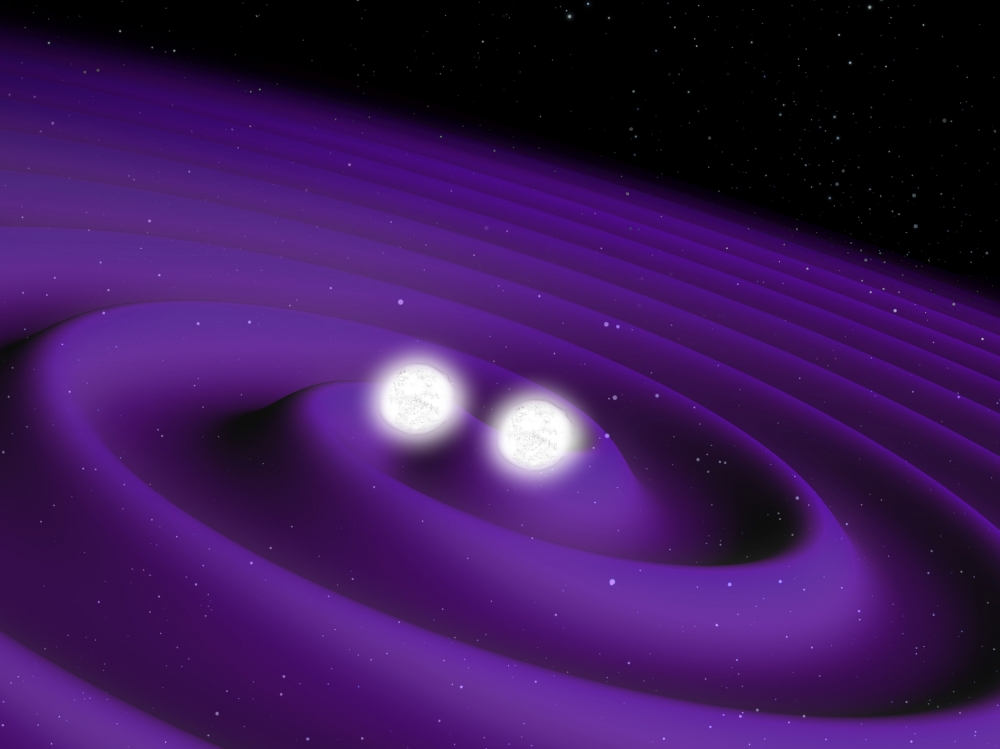
Ripples in spacetime travel at the speed of light. That fact, confirmed by the recent detection of a pair of colliding stellar corpses, kills a whole category of theories that mess with the laws of gravity to explain why the universe is expanding as fast as it is.

On October 16, physicists announced that the Advanced Laser Interferometer Gravitational-Wave Observatory, LIGO, had detected gravitational waves from a neutron star merger (SN Online: 10/16/17). Also, the neutron stars emitted high-energy light shortly after merging. The Fermi space telescope spotted that light coming from the same region of the sky 1.7 seconds after the gravitational wave detection. That observation showed for the first time that gravitational waves, the shivers in spacetime set off when massive bodies move, travel at the speed of light to within a tenth of a trillionth of a percent.

Within a day, five papers were posted at arXiv.org mourning hundreds of expanding universe theories that predicted gravitational waves should travel faster than light — an impossibility without changes to Einstein’s laws of gravity. These theories “are very, very dead,” says the coauthor of one of the papers, cosmologist Miguel Zumalacárregui of the Nordic Institute for Theoretical Physics, or NORDITA, in Stockholm. “We need to go back to our blackboards and start thinking of other alternatives.”

See full text


Chandrasekhar’s role in 20th-century science

undefined

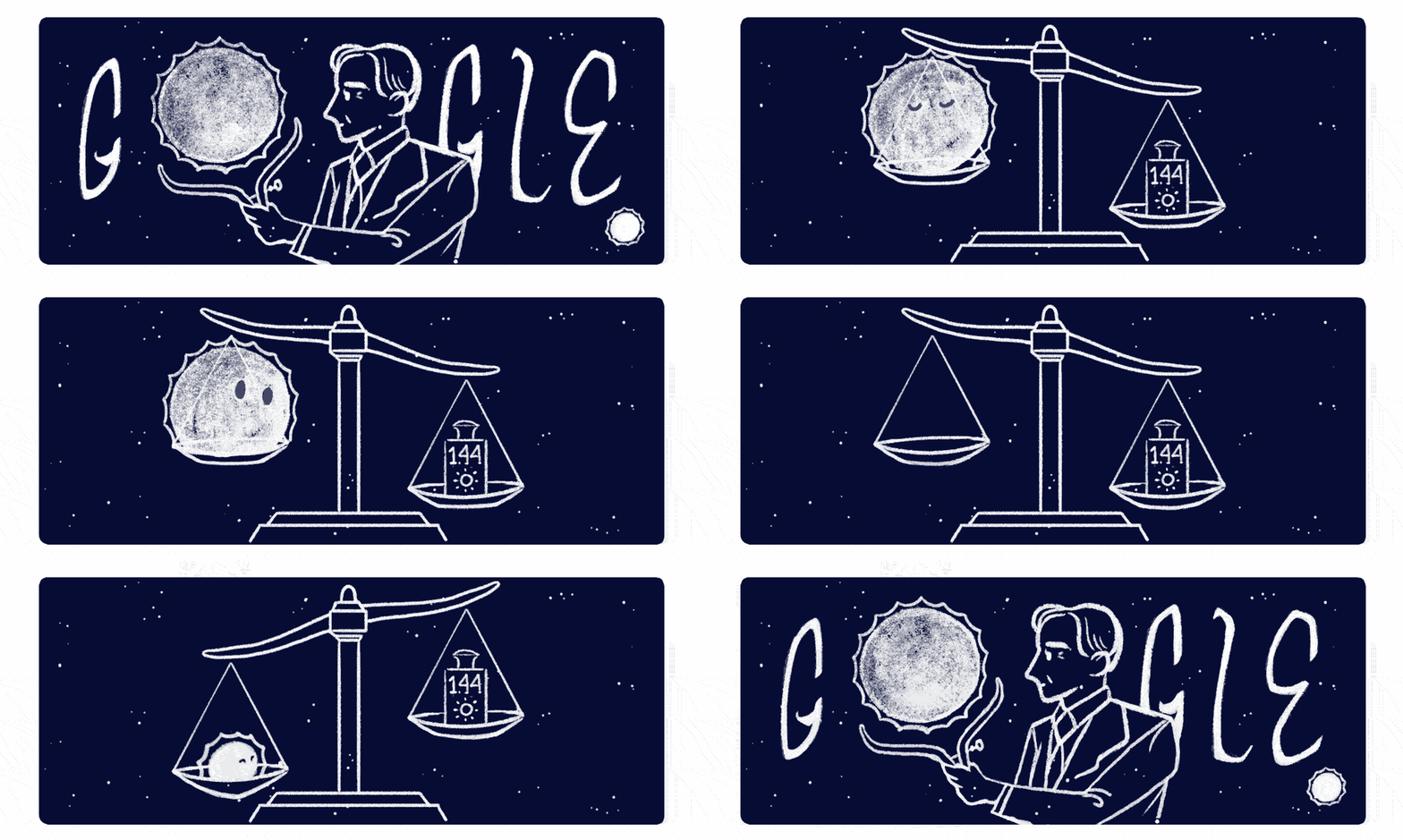
19 Οκτωβρίου 2017  ---  S. Chandrasekhar’s 107th Birthday

Freeman Dyson: Once the astrophysics community had come to grips with a calculation performed by a 19-year-old student sailing off to graduate school, the heavens could never again be seen as a perfect and tranquil dominion.

Physics Today 63, 12, 44 (2010); doi: http://dx.doi.org/10.1063/1.3529001


In 1946 Subrahmanyan Chandrasekhar gave a talk at the University of Chicago entitled “The Scientist.” 1 He was then 35 years old, less than halfway through his life and less than a third of the way through his career as a scientist, but already he was reflecting deeply on the meaning and purpose of his work. His talk was one of a series of public lectures organized by Robert Hutchins, then the chancellor of the university. The list of speakers is impressive, and included Frank Lloyd Wright, Arnold Schoenberg, and Marc Chagall. That list proves two things. It shows that Hutchins was an impresario with remarkable powers of persuasion, and that he already recognized Chandra as a world-class artist whose medium happened to be theories of the universe rather than music or paint. I say “Chandra” because that is the name his friends used for him when he was alive.


BASIC SCIENCE AND DERIVED SCIENCE

Chandra began his talk with a description of two kinds of scientific inquiry. “I want to draw your attention to one broad division of the physical sciences which has to be kept in mind, the division into a basic science and a derived science. Basic science seeks to analyze the ultimate constitution of matter and the basic concepts of space and time. Derived science, on the other hand, is concerned with the rational ordering of the multifarious aspects of natural phenomena in terms of the basic concepts.”


See full text


Gravitational Waves Show How Fast The Universe is Expanding

undefined

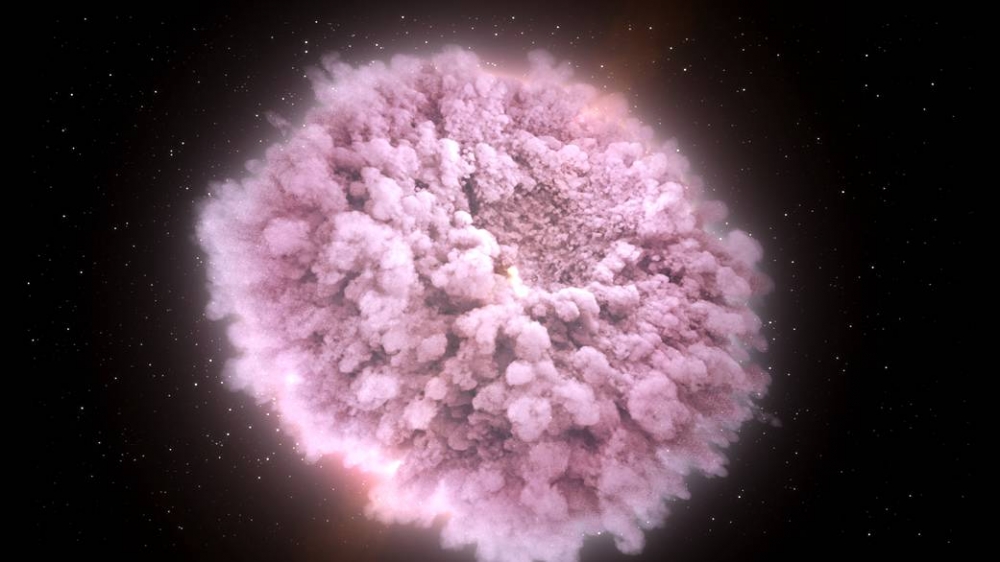
A cloud of debris ejected into space as two neutron stars merge. (Credit: NASA Goddard Space Flight Center/CI Lab)

By Nathaniel Scharping | October 16, 2017

The first gravitational wave observed from a neutron star merger offers the potential for a whole raft of new discoveries. Among them is a more precise measurement of the Hubble constant, which captures how fast our universe is expanding.

Ever since the Big Bang, everything in the universe has been spreading apart. It also turns out that this is happening faster and faster — the rate of expansion is increasing.

We’ve known this for a century, but astronomers haven’t been able to get precise measurements of the increase in rate, due mostly to the fact that they’ve had to cobble together a range of data to estimate how far away things in the universe are. Gravitational wave observations offer a direct means of measuring distances in the universe. The LIGO collaboration is constantly monitoring the universe for the subtle stretching of space-time that huge astronomical collisions can create, and measurements of the amplitude and frequency of the waves it catches hold valuable information for astronomers.


See full text


COLLIDING NEUTRON STARS

undefined

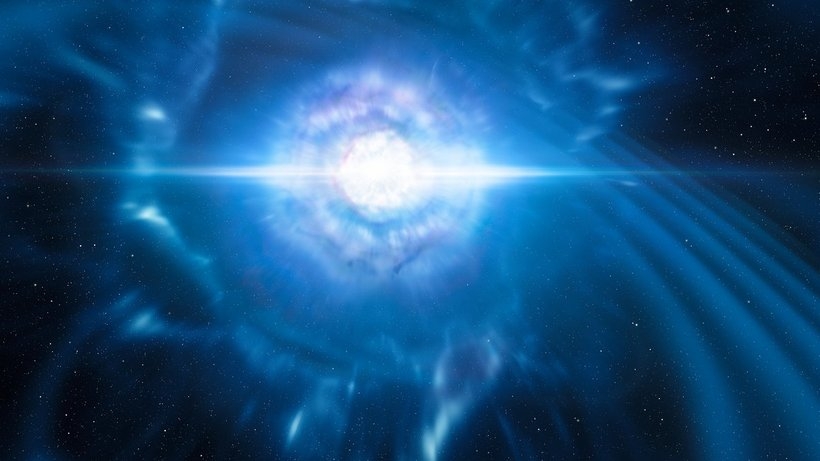
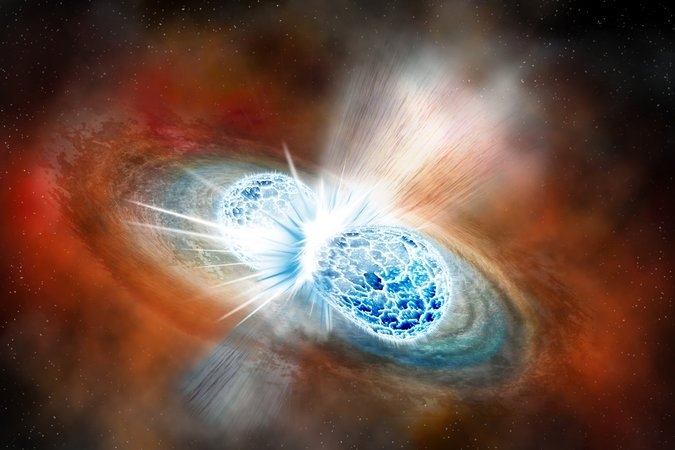
Artist’s impression of two neutron stars – the compact remnants of what were once massive stars – spiralling towards each other just before merging.

The collision of these dense, compact objects produced gravitational waves – fluctuations in the fabric of spacetime – that were detected by the LIGO/Virgo collaboration on 17 August 2017. A couple of seconds after that, ESA's Integral and NASA’s Fermi satellites detected a burst of gamma rays, the luminous counterpart to the gravitational waves emitted by the cosmic clash.

This is the first discovery of gravitational waves and light coming from the same source.

Full story


Das nächste große Ding der Astronomie

undefined

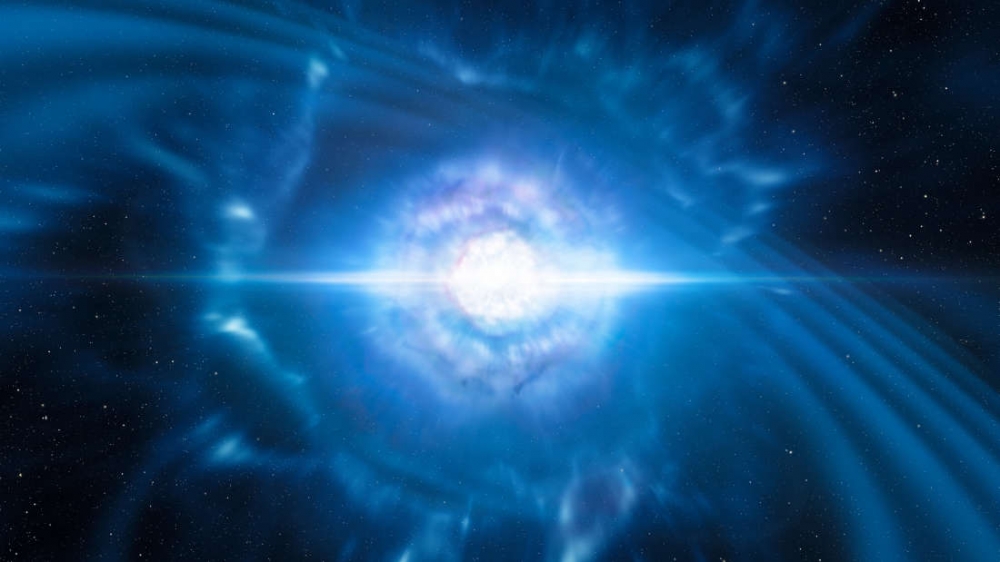
Zwei Neutronensterne verschmelzen und explodieren. Erstmals fingen Forscher ein solches Ereignis direkt ein. Und lösen Grundfragen der Astronomie. © ESO/L. Calçada/M. Kornmesser

Gerade den Nobelpreis eingesackt und nun das: Die Gravitationswellenjäger fangen das Echo einer Sternenexplosion ein und katapultieren die Astronomie in eine neue Ära.


Von Ulrich Schnabel  -- 16. Oktober 2017

Das Leben schreibt bekanntlich die besten Geschichten, und die Erforschung der Gravitationswellen gehört sicher zu den schönsten Storys der modernen Wissenschaft: Rund 100 Jahre lang blieben sie verborgen, wie Dornröschen hinter der Märchenhecke, und alle Nachweisversuche scheiterten. Dann wurden sie endlich entdeckt, verkündet fast auf den Tag genau 100 Jahre, nachdem Einstein sie postuliert hatte. Und seither geht es Schlag auf Schlag: Immer neue Gravitationswellenfunde wurden in den vergangenen Monaten vermeldet, gerade wurde ihr Nachweis mit dem Nobelpreis geehrt und nun das nächste große Ding: Weltweit jubeln Astronomen über einen ganz besonderen Fund, der gleich mehrere kosmische Rätsel auf einmal löst.

"Es kommt nur selten vor, dass ein Wissenschaftler Zeuge des Beginns einer neuen Ära werden kann", sagt die italienische Astronomin Elena Pian, eine der Entdeckerinnen. Doch der heute vorgestellte Fund sei genau ein solch historischer Moment. Ähnlich euphorisch klingen ihre Kollegen. "Wir befinden uns jetzt im Zeitalter der Multi-Messenger-Astronomie!" So triumphierend formuliert es der britische Astrophysiker Andrew Levan, Autor eines von insgesamt sieben (!) Fachartikeln, in denen die Entdeckung in den Zeitschriften Nature und Nature Astronomy ausgebreitet wird.

Full text full


First-seen neutron star collision creates light, gravitational waves and gold

undefined

By Ashley Strickland, CNN
Updated 2325 GMT (0725 HKT) October 16, 2017


(CNN)For the first time, two neutron stars in a nearby galaxy have been observed engaging in a spiral death dance around one another until they collided. What resulted from that collision is being called an "unprecedented" discovery that is ushering in a new era of astronomy, scientists announced Monday.

"We can now fill in a few more tiles in the jigsaw puzzle that is the story of our universe," said Laura Cadonati, deputy spokeswoman for the LIGO Scientific Collaboration and professor in the school of physics at Georgia Tech.
The collision created the first observed instance of a single source emitting ripples in space-time, known as gravitational waves, as well as light, which was released in the form of a two-second gamma ray burst. The collision also created heavy elements such as gold, platinum and lead, scattering them across the universe in a kilonova -- similar to a supernova -- after the initial fireball.


See full text


Astronomers just proved the incredible origin of nearly all gold, platinum, and silver in the universe

undefined

An illustration of two neutron stars colliding. NASA


  • For the first time, astronomers have detected a neutron-star collision.
  • Gravitational waves heard by two detectors pinpointed the source to a galaxy 130 million light-years away.
  • The collision produced a radioactive "kilonova" that forged hundreds of Earths' worth of platinum, gold, silver, and other atoms.
  • The discovery solves a longstanding mystery about the origins of heavy elements.

Platinum and gold are among the most precious substances on Earth, each fetching roughly $1,000 an ounce.

However, their allure may grow stronger — and weirder — thanks to a groundbreaking new finding about their violent, radioactive, and cosmic origins.

On Monday, scientists who won a Nobel Prize for their discovery of gravitational waves, or ripples in the fabric of space, announced the first detection of the collision of two neutron stars.

See full text


In A Historic Discovery, A Neutron Star Merger Has Been Observed For The Very First Time

undefined

The fifth observation of gravitational waves (GW) marks the beginning of a new era in astronomy. On August 17, 2017, the LIGO and VIRGO collaborations detected neutron stars merging for the first time and immediately alerted observatories around the world. In a matter of hours the event had been located, another first for GW astronomy, and telescopes around the world begun studying it almost immediately.

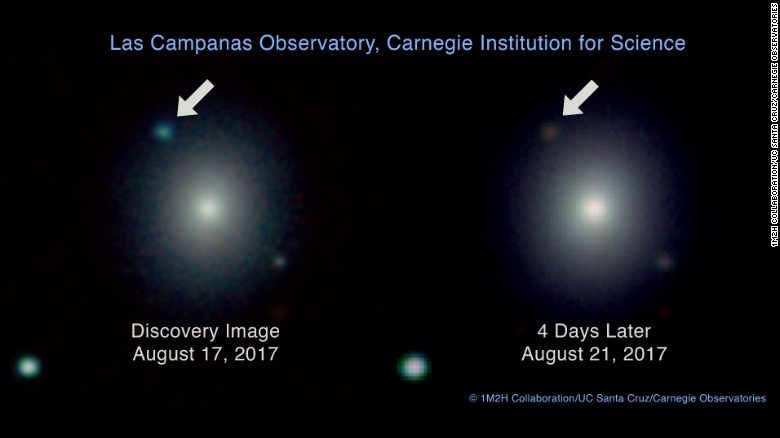
The event observed, called GW170817, was produced in galaxy NGC 4993, located 130 million light-years from Earth. The gravitational signal was the strongest ever observed, lasting over 100 seconds, and it emitted a gamma-ray burst (GRBs), providing the first piece of evidence that GRBs are produced by neutron star collisions. It also provided the strongest evidence yet that neutron star mergers are responsible for the creation of the heaviest elements in the universe, like gold and platinum.

See full text


A New Blast May Have Forged Cosmic Gold

undefined

For decades, researchers believed that violent supernovas forged gold and other heavy elements. But many now argue for a different cosmic quarry.

Across history and folklore, the question of where Earth’s gold came from — and maybe how to get more of it — has invited fantastical explanation. The Inca believed gold fell from the sky as either the tears or the sweat of the sun god Inti. Aristotle held that gold was hardened water, transformed when the sun’s rays penetrated deep underground. Isaac Newton transcribed a recipe for making it with a philosopher’s stone. Rumpelstiltskin, of course, could spin it from straw.


See full text


LIGO Detects Fierce Collision of Neutron Stars for the First Time


undefined 

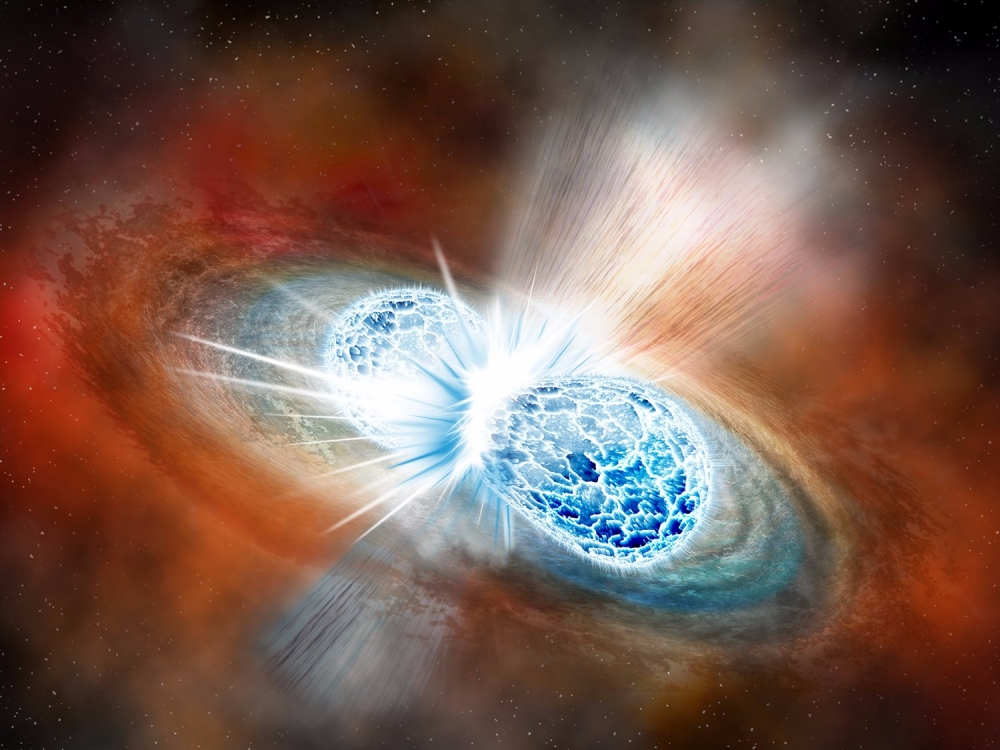
 An artist’s rendering of the merger of two neutron stars from Aug. 17. Credit Robin Dienel/The Carnegie Institution for Science


Astronomers announced on Monday that they had seen and heard a pair of dead stars collide, giving them their first glimpse of the violent process by which most of the gold and silver in the universe was created.

The collision, known as a kilonova, rattled the galaxy in which it happened 130 million light-years from here in the southern constellation of Hydra, and sent fireworks across the universe. On Aug. 17, the event set off sensors in space and on Earth, as well as producing a loud chirp in antennas designed to study ripples in the cosmic fabric. It sent astronomers stampeding to their telescopes, in hopes of answering one of the long-sought mysteries of the universe.

LIGO Detects Fierce Collision of Neutron Stars for the First Time


Where Gravity Is Weak and Naked Singularities Are Verboten

undefined

Natalie Wolchover -- June 20, 2017

Recent calculations tie together two conjectures about gravity, potentially revealing new truths about its elusive quantum nature.


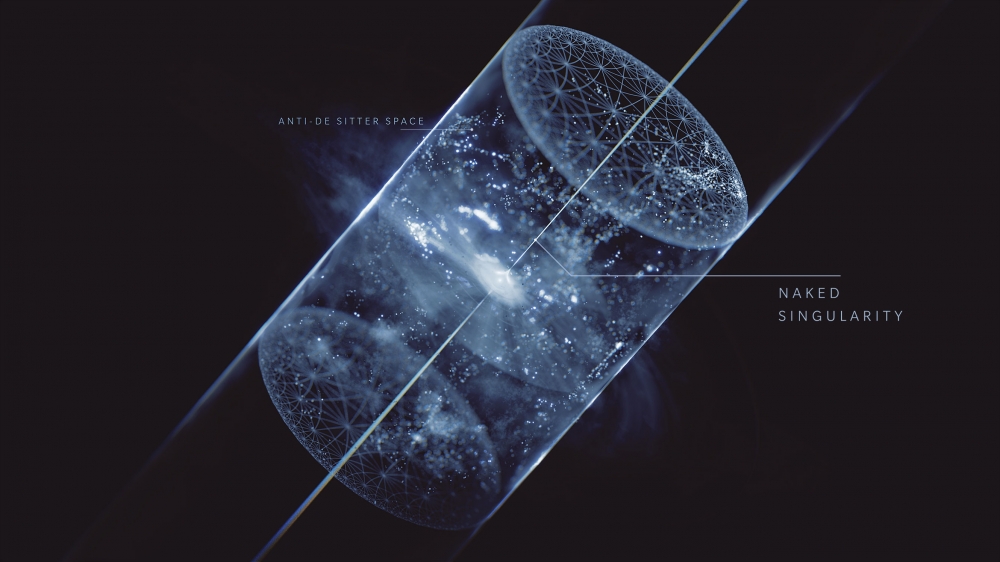
Physicists have wondered for decades whether infinitely dense points known as singularities can ever exist outside black holes, which would expose the mysteries of quantum gravity for all to see. Singularities — snags in the otherwise smooth fabric of space and time where Albert Einstein’s classical gravity theory breaks down and the unknown quantum theory of gravity is needed — seem to always come cloaked in darkness, hiding from view behind the event horizons of black holes. The British physicist and mathematician Sir Roger Penrose conjectured in 1969 that visible or “naked” singularities are actually forbidden from forming in nature, in a kind of cosmic censorship. But why should quantum gravity censor itself?

Now, new theoretical calculations provide a possible explanation for why naked singularities do not exist — in a particular model universe, at least. The findings indicate that a second, newer conjecture about gravity, if it is true, reinforces Penrose’s cosmic censorship conjecture by preventing naked singularities from forming in this model universe. Some experts say the mutually supportive relationship between the two conjectures increases the chances that both are correct. And while this would mean singularities do stay frustratingly hidden, it would also reveal an important feature of the quantum gravity theory that eludes us.

“It’s pleasing that there’s a connection” between the two conjectures, said John Preskill of the California Institute of Technology, who in 1991 bet Stephen Hawking that the cosmic censorship conjecture would fail (though he actually thinks it’s probably true).


See full text


LIGO-VIRGO SCIENTISTS TO DISCUSS NEW DEVELOPMENTS IN GRAVITATIONAL-WAVE ASTRONOMY

undefined

By Nicolas Arnaud  -- October 11, 2017


*** MEDIA ADVISORY ***
Issued jointly by the LIGO Laboratory, LIGO Scientific Collaboration, National Science Foundation, and Virgo Collaboration

Scientists representing LIGO, Virgo, and some 70 observatories will reveal new details and discoveries made in the ongoing search for gravitational waves.

WHAT: Journalists are invited to join the National Science Foundation as it brings together scientists from the LIGO and Virgo collaborations, as well as representatives for some 70 observatories, on Monday, October 16, at 16:00 CEST at the National Press Club in Washington, D.C.

The gathering will begin with an overview of new findings from LIGO, Virgo, and partners that span the globe, followed by details from telescopes that work with the LIGO and Virgo Collaboration to study extreme events in the cosmos.

The first detection of gravitational waves, made on September 14, 2015 and announced on February 11, 2016, was a milestone in physics and astronomy; it confirmed a major prediction of Albert Einstein’s 1915 general theory of relativity, and marked the beginning of the new field of gravitational-wave astronomy. Since then, there have been three more confirmed detections, one of which (and the most recently announced) was the first confirmed detection seen jointly by both the LIGO and Virgo detectors.

The published articles announcing LIGO-Virgo’s first, second, and third confirmed detections have been cited more than 1,700 times (total), according to the Web of Science citation counts. A fourth paper on the three-detector observation was published on October 6; a manuscript was made publicly available on September 27.

WHEN: Monday, October 16, 2017  16:00 CEST


** Panels to begin at 16:00 and 17:15, with a 15-minute break in between. Event expected to conclude by 18:30.


See full text

Media Advisory: Press Conference at ESO HQ Announcing Unprecedented Discovery

undefined

ESO will hold a press conference on 16 October 2017 at 16:00 CEST, at its Headquarters in Garching, Germany, to present groundbreaking observations of an astronomical phenomenon that has never been witnessed before.

The event will be introduced from ESO’s Paranal Observatory in Chile by the Director General, Xavier Barcons, and will feature talks by representatives of many research groups around Europe.

This invitation is addressed exclusively at media representatives. To participate in the conference, bona fide members of the media must register by completing an online form. Please indicate whether you wish to come in person to the press conference or if you will participate online only.

By registering for the conference, journalists agree to honour an embargo, details of which will be provided after registration, and not to publish or discuss any of the material presented before the start of the conference on 16 October 2017 at 16:00 CEST.

On site journalists will have a question and answer session with panelists during the conference. We will also take questions from journalists participating online. In-person individual interviews right after the conference are also possible.


See full text


Newer posts → Home ← Older posts